3D Printed Grip Modifications Transforming Arcade Stick Handling Dynamics in Fighting Game Esports Circuits
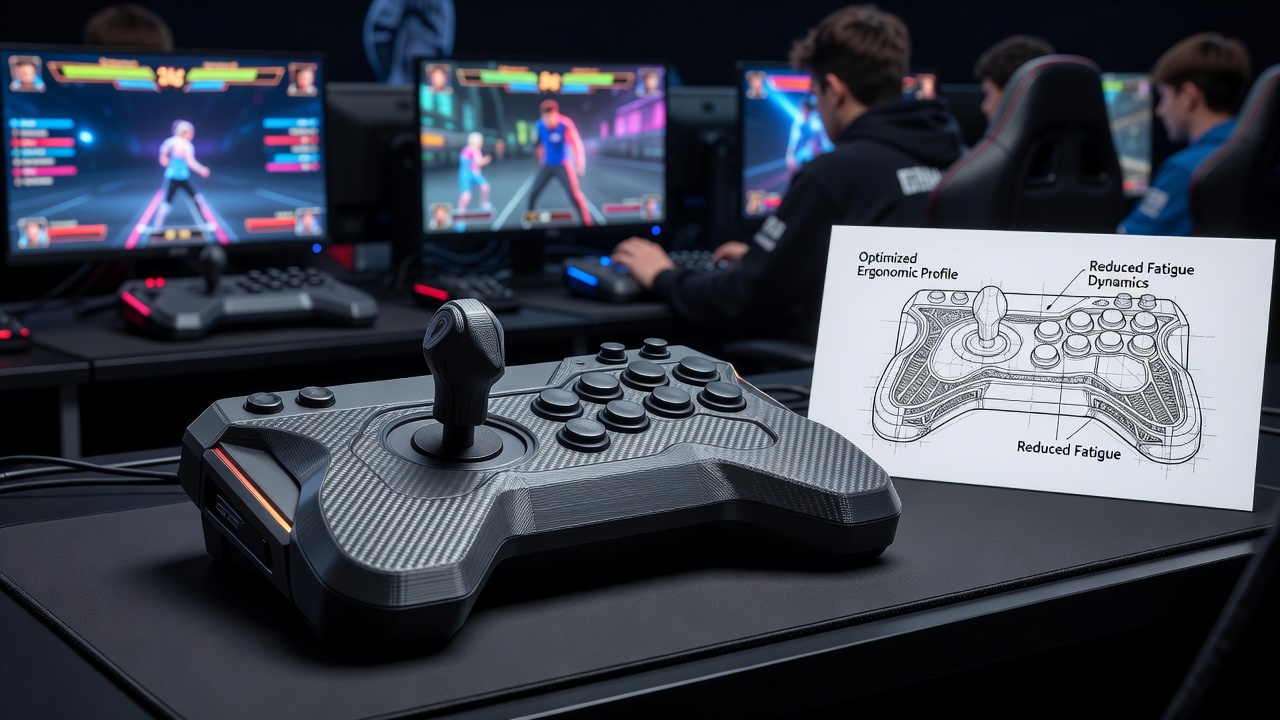
Arcade sticks remain central to fighting game competitions, and players continue to experiment with modifications that alter how hands interact with controls during intense matches. Researchers have documented how 3D printed grip components adjust contact points, distribute pressure differently across fingers and palms, and influence response times in high-stakes environments.
Material Choices and Design Approaches
Teams and individual competitors source filaments such as TPU for flexibility and PLA composites for rigidity, then print attachments that snap onto existing lever shafts or button housings. These additions create contoured surfaces that match palm curvature, reduce slippage under sweat, and position thumbs at angles that support rapid directional inputs without wrist extension. Data from university labs in North America show that textured patterns printed at 0.2 millimeter layer heights increase friction coefficients by measurable margins compared with stock plastic.
Design software allows precise scaling based on hand measurements collected through simple scanning apps, and files circulate through community repositories where contributors refine versions after tournament feedback. One modification series incorporates subtle ridges along the lever base that guide neutral positioning, while another adds extended wings that cradle the pinky during diagonal motions common in certain character archetypes.
Performance Shifts in Competitive Play
Handling dynamics change because grip geometry alters force application vectors, which in turn affects lever travel consistency and button actuation speed. Observers at major circuits note that players using these modifications execute longer chains of quarter-circle inputs with fewer micro-adjustments, and data logs from practice sessions indicate reduced peak muscle activation in forearm groups. European research groups tracking motion capture during simulated matches recorded smoother velocity curves when custom grips replaced factory parts.
Adoption Across Circuits Through Mid-2026
By June 2026, several regional qualifiers incorporated equipment checks that permitted 3D printed parts provided they maintained stock dimensions and did not add electronic functions. This regulatory clarity encouraged broader experimentation, with teams in Asia-Pacific regions leading in multi-material prints that combine rigid cores with flexible outer layers for vibration dampening. Figures from organizer reports reveal that over half of top-eight finishers at select events that month had incorporated at least one printed grip element.

Case examples include a Canadian player who printed a lever knob with asymmetric beveling to favor forward-leaning inputs, resulting in documented improvements in dash-cancel consistency across multiple characters. Another instance involved an Australian squad that shared a button cluster surround reducing finger travel distance, which teammates adapted for different hand sizes through parametric adjustments. These adaptations spread through shared print files rather than commercial products.
Ergonomic Data and Measurement Methods
Studies conducted at technical institutes measure wrist angles, grip force distribution, and fatigue onset using sensor-equipped prototypes. Results indicate that optimized contours lower sustained pressure on the thenar eminence by redistributing load toward the hypothenar area, and participants report extended training windows before discomfort appears. Organizations tracking player biometrics during events have begun correlating these grip changes with lower reported instances of repetitive strain markers in post-tournament surveys.
Calibration routines now include grip-specific warm-up sequences where players perform standardized input patterns while sensors record baseline stability, and adjustments follow when deviation thresholds exceed set parameters. This feedback loop accelerates refinement cycles between events.
Community Fabrication Networks
Fabrication occurs through local maker spaces and home setups equipped with consumer-grade printers, where enthusiasts iterate on open-source designs released under permissive licenses. Forums dedicated to fighting game hardware maintain version histories that document print settings, filament brands, and observed durability after hundreds of hours of use. Trade groups focused on competitive gaming hardware occasionally host design challenges that highlight innovations such as modular inserts allowing quick swaps between different lever profiles mid-tournament.
Supply chains for specialty filaments remain stable, with regional distributors offering bulk options that lower per-unit costs for teams preparing multiple sticks. Maintenance involves periodic inspection for layer delamination, and replacement prints take under an hour on standard machines.
Conclusion
3D printed grip modifications continue to integrate into fighting game esports equipment as measurement tools and fabrication access expand. Tournament data from 2026 shows measurable shifts in input execution patterns tied to these components, while ongoing studies track long-term effects on player physiology. The combination of accessible printing technology and shared design resources supports incremental refinements that align equipment more closely with individual biomechanics across global circuits.