Advanced Filament Selection Processes Guiding the Creation of Custom 3D Printed Mounts for Securing Multiple Monitors in Dual PC Streaming Environments
Sam Simon · Jul 21, 2026
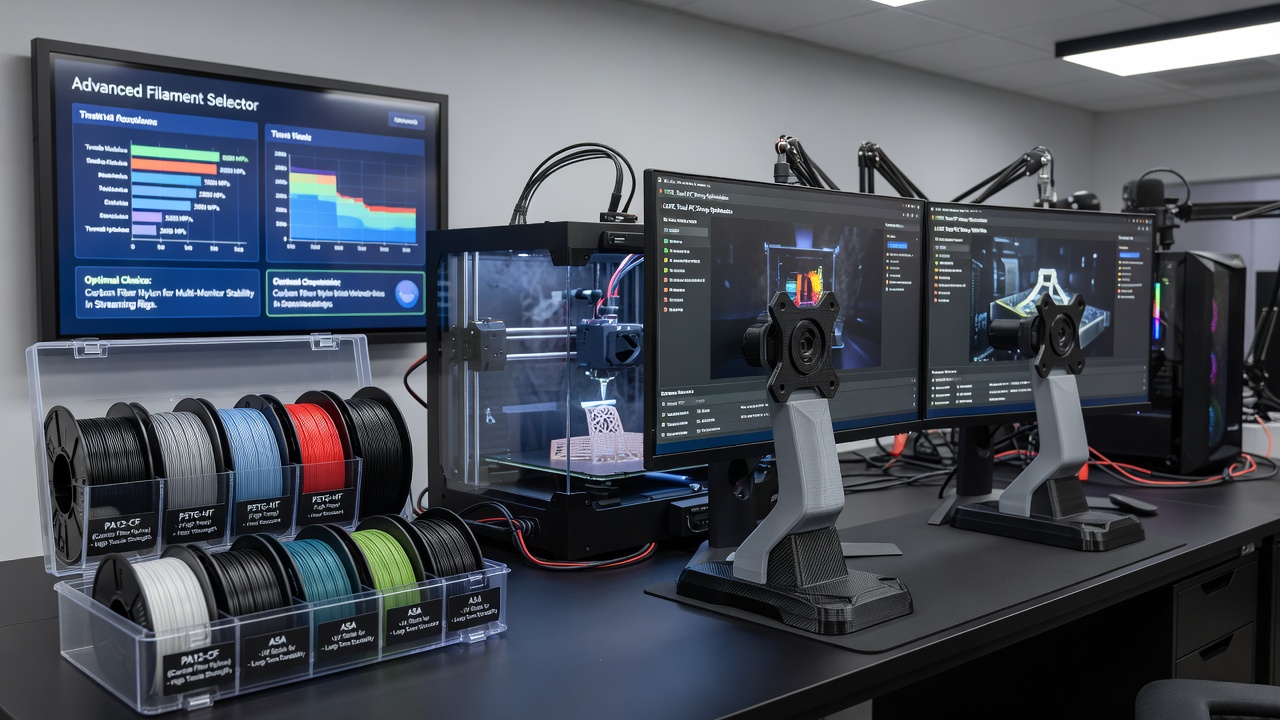
Advanced Filament Selection Processes Guiding the Creation of Custom 3D Printed Mounts for Securing Multiple Monitors in Dual PC Streaming Environments
Professionals in competitive streaming environments often rely on custom 3D printed mounts to position multiple monitors securely across dual PC configurations, and filament selection plays a central role in determining the structural integrity of those mounts under sustained loads. Data from additive manufacturing studies shows that material properties such as tensile strength, thermal stability, and dimensional accuracy directly influence how well a mount maintains alignment when supporting screens that range from 27 to 49 inches each. Observers note that streaming setups frequently operate for extended periods, which introduces variables like localized heat from graphics cards and constant vibration from cooling fans, so filament choices must account for these conditions from the outset. Engineers begin the selection process by evaluating base polymers against the specific demands of monitor support. PETG and its carbon-fiber-reinforced variants deliver higher impact resistance compared with standard PLA, while nylon blends provide flexibility that reduces stress fractures at mounting points. Research indicates that composite filaments containing glass or carbon particles increase stiffness without adding excessive weight, which becomes relevant when a single mount holds three or more displays in a stacked or side-by-side arrangement. In July 2026, updated material datasheets released by several manufacturers highlighted improved interlayer adhesion in newer PETG formulations, allowing prints to withstand higher shear forces during installation and daily adjustments.Key Criteria in Filament Evaluation
Selection protocols typically combine laboratory testing with real-world simulation. Teams measure deflection under incremental loads that mimic monitor weight plus safety margins, and they track creep behavior over 72-hour periods to replicate nonstop streaming sessions. Figures from academic trials reveal that carbon-fiber PETG exhibits roughly 40 percent less creep than unreinforced PETG when subjected to 15-kilogram loads at 40 degrees Celsius, conditions commonly encountered near high-performance GPUs. Those conducting the tests also examine moisture absorption rates, because nylon-based filaments can swell in humid environments and alter mounting tolerances if not dried before printing.
Additional factors include printability and post-processing requirements. High-temperature filaments such as polycarbonate or PEEK demand enclosed printers with heated chambers, yet they offer superior heat deflection temperatures above 140 degrees Celsius. Data shows that these materials maintain rigidity even when positioned directly above exhaust vents, whereas lower-grade options soften and allow gradual monitor sag. Printer calibration logs from multiple facilities confirm that consistent extrusion temperatures between 240 and 260 degrees Celsius produce the layer bonding necessary for load-bearing components in dual-PC rigs.Design Integration and Printing Workflow
Once a filament is chosen, designers incorporate reinforcement geometry such as internal lattices or thickened flanges at attachment points. Software simulations predict stress concentrations around VESA mount holes, prompting adjustments like added gussets or tapered wall thicknesses. A case documented at one European research center demonstrated that switching from standard PETG to a 20-percent carbon-fiber version reduced maximum deflection by 2.3 millimeters under identical print parameters, eliminating the need for secondary metal brackets in many configurations.
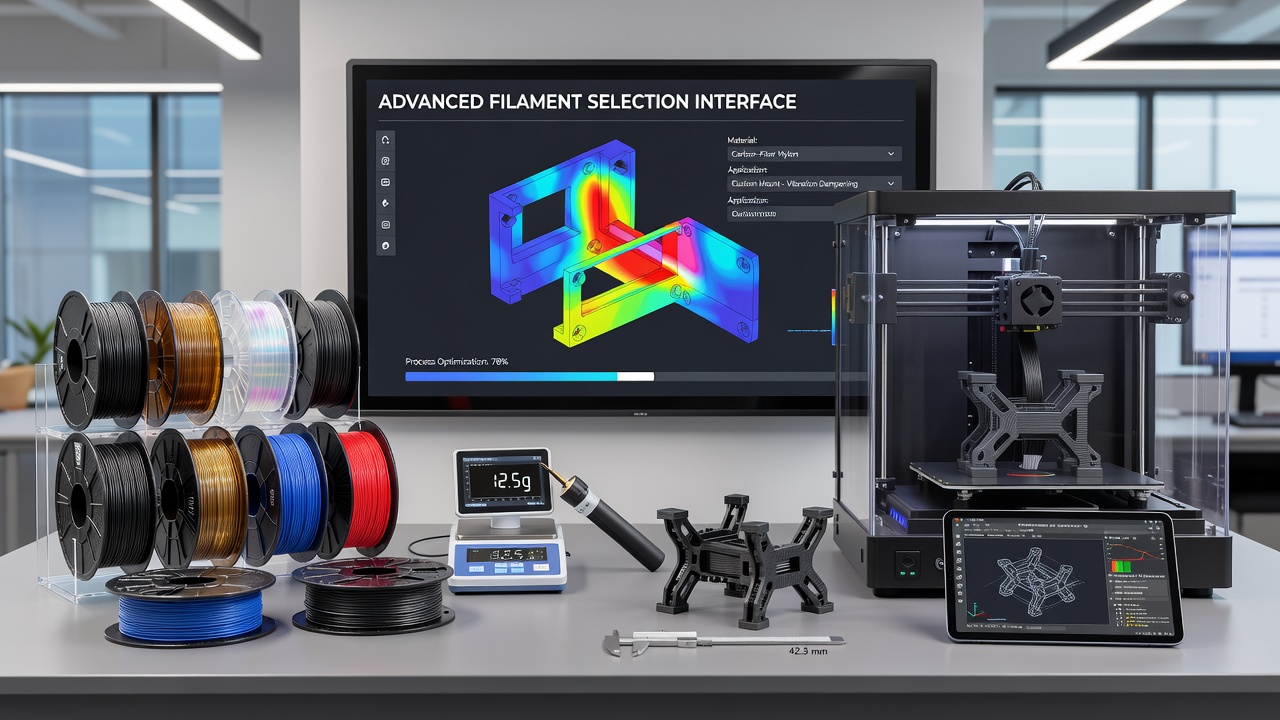 Printing parameters receive equal attention during production. Layer heights of 0.2 millimeters combined with 50-percent infill density balance strength against print time, while perimeter counts of four or more walls improve resistance to torsional forces when monitors are repositioned. Post-print annealing at controlled temperatures further enhances crystallinity in certain filaments, boosting heat resistance without compromising dimensional accuracy. Technicians report that annealing cycles lasting two hours at 80 degrees Celsius produce measurable gains in load capacity for PETG-based mounts.
Performance in Dual-PC Streaming Contexts
Streaming environments introduce additional constraints because cable management and airflow pathways must remain unobstructed by the mounts themselves. Custom designs often integrate channels for HDMI, DisplayPort, and power cables, which requires filaments that retain sharp internal corners without stringing or oozing during long prints. Industry reports from North American testing facilities note that matte-surface filaments reduce visible layer lines, improving aesthetics in camera-facing setups while maintaining mechanical performance.
Long-term durability testing tracks how mounts respond to repeated assembly and disassembly during event travel or studio reconfigurations. Nylon-carbon composites have shown resilience in these cycles, with minimal wear at pivot joints after 200 attachment cycles. Meanwhile, thermal cycling between 20 and 55 degrees Celsius simulates daily heat buildup from dual-PC operation, and results indicate that properly selected filaments retain original dimensions within 0.3 percent tolerance after 500 cycles.Conclusion
Filament selection therefore functions as a foundational step that determines whether custom 3D printed mounts can reliably secure multiple monitors across dual-PC streaming stations. Systematic evaluation of mechanical properties, thermal behavior, and print parameters enables consistent outcomes that align with the operational demands of professional environments. Continued refinement of composite materials and testing protocols supports ongoing improvements in mount performance as hardware configurations evolve.