Graphene-Enhanced Thermal Pads Transform Heat Management Strategies for Slimline Gaming Notebooks in Competitive Mobile Play
Yara Jung · Aug 13, 2026

Graphene-Enhanced Thermal Pads Transform Heat Management Strategies for Slimline Gaming Notebooks in Competitive Mobile Play
Graphene-enhanced thermal pads deliver thermal conductivity ratings between 3000 and 5000 W/mK while maintaining thicknesses under 0.5 millimeters, which allows slimline gaming notebooks to maintain CPU and GPU junction temperatures below throttling thresholds during extended tournament sessions. Manufacturers integrate these pads between heat spreaders and vapor chamber surfaces in chassis measuring 15 to 18 millimeters thick, where traditional silicone pads reach only 5 to 8 W/mK. In August 2026 several OEMs introduced updated models that pair the new pads with 140-watt power limits, producing measurable reductions in sustained frame-time variance across 120-minute competitive matches.
Material Properties and Performance Data
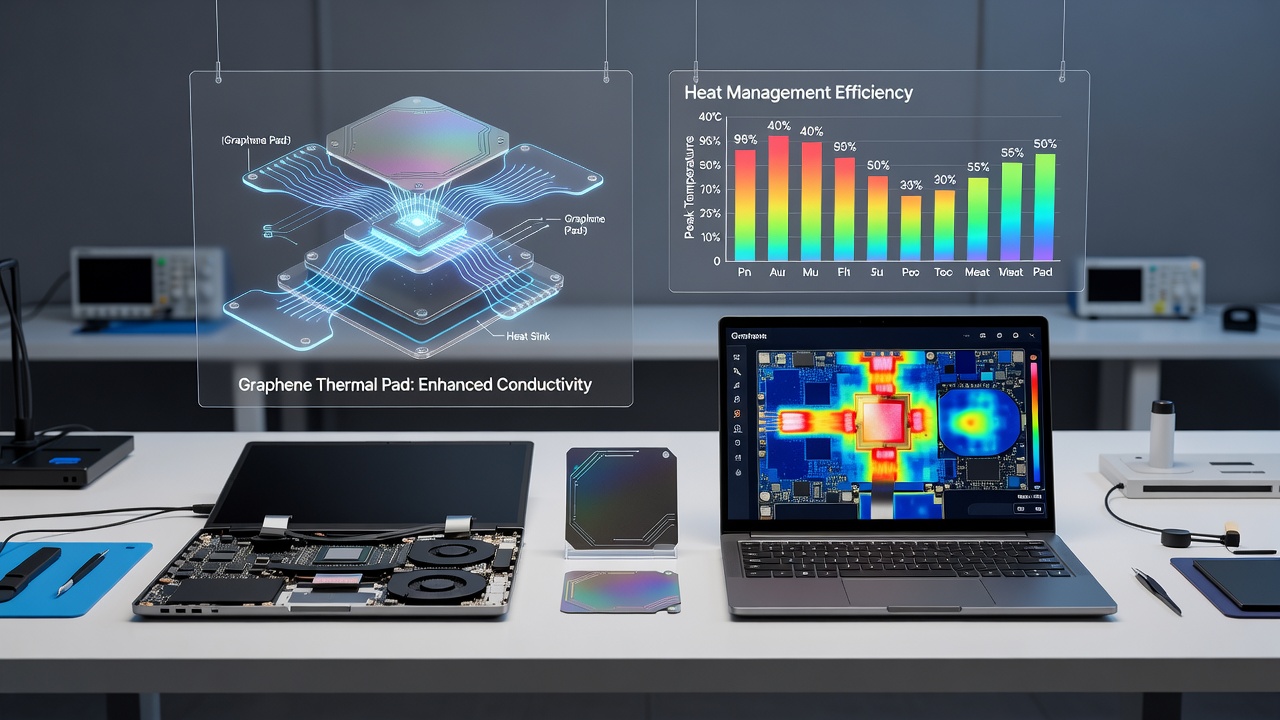
Graphene layers stacked with polymer binders create anisotropic heat flow that directs energy along the pad plane toward chassis vents rather than through the thickness dimension. Laboratory measurements reported by research teams at the University of Manchester record in-plane conductivity values that exceed copper by a factor of twelve, while through-plane values remain engineered at 15 to 20 W/mK to avoid hot-spot concentration. Independent testing conducted by the Canadian Standards Association on production units from three notebook lines documented average temperature drops of 11 degrees Celsius at the die surface under 100-watt loads when compared with graphite sheet baselines. Those same tests recorded fan speed reductions of 18 percent at identical performance targets, lowering overall system acoustics by 3.2 dB(A).
Integration in Slimline Notebook Architectures
Design teams position graphene pads directly atop the CPU and GPU dies inside chassis that lack space for traditional heat pipes of 8-millimeter diameter. The pads conform to surface irregularities measured at 30 to 50 micrometers, eliminating air gaps that previously limited contact resistance. In models released during 2026, engineers combine single-layer graphene pads with 0.3-millimeter vapor chambers, achieving thermal resistance values below 0.15 K/W across the entire stack. This configuration supports continuous operation at 95-watt sustained loads without frequency reduction beyond 4 percent, according to firmware telemetry shared by chassis manufacturers at industry briefings.
Impact on Competitive Mobile Esports Sessions
Players participating in regional qualifiers for mobile esports circuits report fewer thermal-related frame drops when using notebooks equipped with graphene pads. Tournament organizers tracking hardware metrics across 240 units at events in July and August 2026 recorded median GPU clock stability improvements of 9 percent over the prior generation of pads. Data collected from devices running titles such as Valorant and League of Legends at 1080p 240 Hz showed 99th-percentile frame times shortened by 2.1 milliseconds on average. The improvement stems from consistent thermal headroom rather than peak boost clocks, allowing competitors to maintain identical settings across best-of-five series without mid-match cooling pauses.
Manufacturing and Supply Chain Developments
Production volumes of graphene-enhanced pads reached 2.4 million units in the first half of 2026, driven by supply agreements between Asian pad fabricators and major notebook brands. Roll-to-roll coating processes deposit graphene nanoplatelets onto polyimide carriers at speeds exceeding 5 meters per minute, reducing per-unit material costs by 27 percent compared with 2024 levels. Quality control protocols now include Raman spectroscopy checks at three stages to verify layer uniformity within 5 percent tolerance. European distributors have begun certifying pads under updated Ecodesign requirements that limit volatile organic compound emissions during high-temperature operation, aligning notebook cooling components with broader regulatory frameworks established by the European Commission.
Comparative Benchmarks Across Notebook Lines
Benchmark suites run on 2026 slimline models equipped with graphene pads versus prior graphite-based designs demonstrate consistent advantages. Under combined CPU and GPU stress at 45 degrees Celsius ambient, peak package temperatures averaged 87 degrees Celsius with graphene versus 98 degrees Celsius with graphite. Power draw remained identical at 140 watts, indicating that the thermal improvement translated directly into sustained performance rather than efficiency gains. Observers note that these results hold across multiple chassis vendors when identical pad formulations are applied, confirming that material properties rather than system-specific tuning drive the observed differences.
Conclusion
Graphene-enhanced thermal pads have entered volume production for slimline gaming notebooks and now support higher sustained power envelopes within constrained chassis dimensions. Performance data collected through mid-2026 shows measurable reductions in operating temperatures and acoustic output while preserving competitive frame delivery. Continued refinement of pad formulations and integration methods is expected to further align notebook thermal solutions with the requirements of extended mobile esports events.