Liquid Cooling Loops Evolving Cable Routing Strategies in Compact Tournament PCs for Mobile Esports Teams
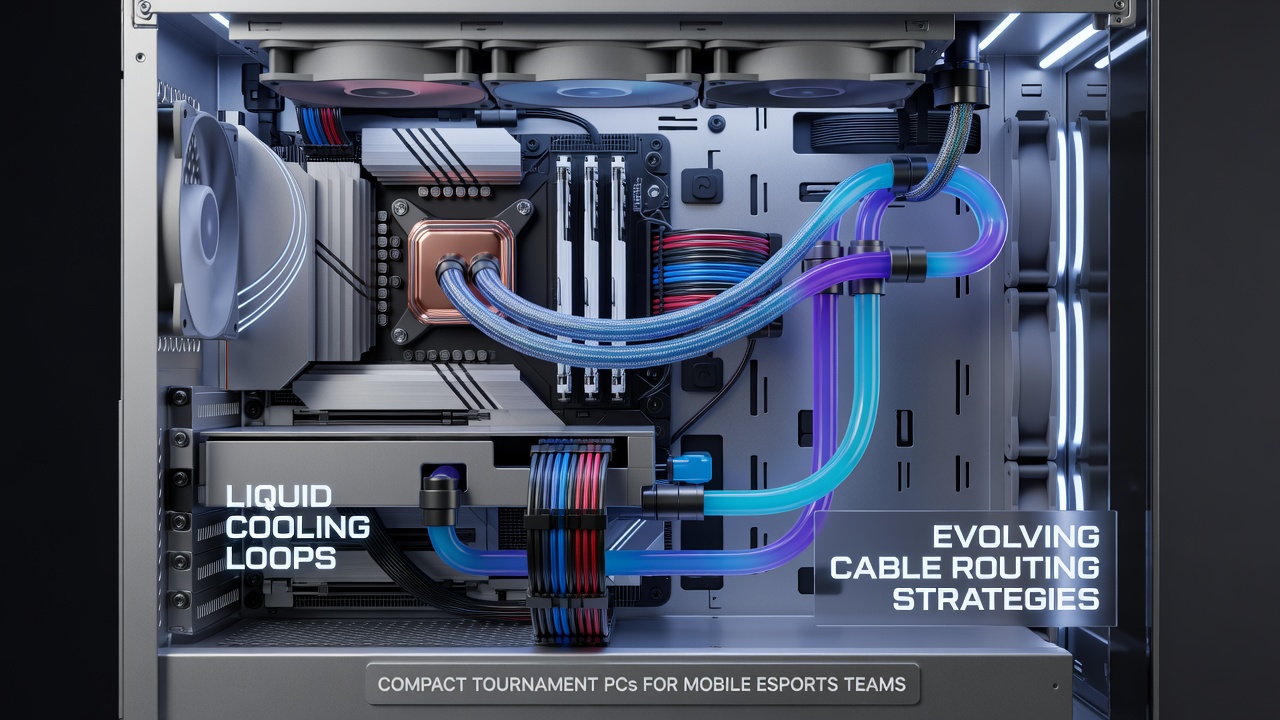
Compact tournament PCs used by mobile esports teams rely on liquid cooling loops that integrate directly with cable routing layouts, and this integration shapes how builders arrange power delivery, data lines, and pump controls within limited chassis volumes. Teams traveling between events pack systems that maintain stable thermals during extended matches while fitting into airline-approved cases, so designers route tubing alongside SATA, PCIe, and RGB cables to avoid airflow blockages and reduce bend radii that stress connections over repeated setups.
Integration Patterns in Mobile Esports Hardware
Manufacturers position radiator fans at the front or top of small form factor cases, which forces cable bundles to travel along side panels rather than across the motherboard tray, and this layout change emerged prominently as teams adopted custom loops for CPUs and GPUs in systems under 20 liters. Data from industry reports indicate that cable length reductions of 15 to 25 percent occur when tubing paths dictate shorter power extensions, because builders align 24-pin and 8-pin connectors parallel to soft tubing runs instead of crossing them. Observers note that pump-reservoir combos mounted on the rear wall free up front space, allowing teams to tuck fan controllers and USB hubs behind the graphics card bracket without creating pinch points during transport.
Routing Techniques Shaped by Loop Geometry
Soft tubing loops require gentle curves that accommodate 90-degree fittings at block inlets, so cable channels now follow those same arcs to maintain consistent bend allowances and prevent signal degradation in high-speed data lines. Rigid tubing setups, by contrast, create straight segments that teams exploit for flat cable combs, which secure multiple strands against vibration during bus or train travel. In June 2026 several mobile squads at regional qualifiers demonstrated daisy-chained fan splitters mounted directly to radiator brackets, eliminating separate cable runs that previously added bulk near the pump inlet.
Thermal and Electrical Considerations
Researchers at technical institutes across North America and Europe have documented how proximity between coolant lines and power cables affects electromagnetic interference, with measurements showing reduced noise when grounded shielding sleeves separate the two by at least 15 millimeters. Mobile teams therefore adopt sleeved extensions that match tubing diameter, allowing both elements to share the same grommet cutouts in the motherboard tray. This approach cuts assembly time during on-site rebuilds, because technicians no longer trace individual wires through crowded compartments.

Case Examples from Traveling Teams
One European squad competing in cross-border leagues redesigned its mini-ITX rigs after observing repeated pump failures traced to cables pressing against soft tubing elbows, and the revised layout placed all peripheral connectors on a vertical riser that runs parallel to the return line. Australian organizers reported similar adjustments among Oceania competitors who favor dual-radiator configurations, where exhaust tubing exits near the PSU shroud and forces power cables to exit from the opposite side panel. These modifications appear in event recaps published by regional gaming associations, confirming consistent adoption across multiple continents.
Component Selection and Compatibility Data
Industry surveys compiled by hardware research groups reveal that 240-millimeter radiators paired with low-profile fittings dominate tournament builds because they leave vertical clearance for flat 90-degree power adapters. Teams select modular power supplies with detachable cables precisely because shorter runs align better with loop geometry, reducing unused wire that would otherwise occupy space needed for reservoir sight glasses. Figures from component distributors show a 30 percent increase in sales of right-angle PCIe risers between 2024 and 2026, correlating with the spread of side-mounted graphics cards that sit beside vertical pump units.
Maintenance and Field Adjustments
Technicians working with mobile setups emphasize quick-disconnect fittings that let loops drain without disturbing cable bundles, and this feature becomes essential when visual inspections reveal tubing kinks near cable ties. Quick-swap panels now incorporate magnetic cable channels that snap into place after radiator removal, allowing teams to reconfigure routing between matches without full disassembly. Such practices appear in technical briefings from esports equipment suppliers who track hardware longevity across tournament circuits.
Conclusion
Liquid cooling loops continue to dictate cable routing priorities in compact tournament PCs, because every bend, fitting, and mounting point influences how power and data lines share the same constrained interior. Teams that align these elements report fewer thermal throttling events and faster teardown times between venues. As chassis dimensions stay fixed while component power draws increase, builders will keep refining these integrated strategies to sustain performance under travel conditions.