Nanotube Thermal Interface Compounds Extend GPU Lifespan Metrics in Mini-ITX Esports Tournament Rigs
Sam Simon · Aug 11, 2026

Nanotube Thermal Interface Compounds Extend GPU Lifespan Metrics in Mini-ITX Esports Tournament Rigs
Carbon nanotube thermal interface compounds have entered competitive hardware configurations where space constraints define performance boundaries. These materials combine aligned or dispersed nanotubes with base matrices to achieve thermal conductivities that exceed traditional pastes by factors of three to five times according to laboratory measurements. In mini-ITX chassis used for esports tournament rigs the reduced form factor leaves minimal room for large heatsinks or multiple fans yet GPU loads remain high during extended matches.
Research indicates that nanotube-enhanced compounds lower junction temperatures by 12 to 18 degrees Celsius under sustained 300-watt loads compared with standard ceramic-filled pastes. Lower operating temperatures slow electromigration and dielectric breakdown mechanisms that accumulate over thousands of hours. Data collected from field deployments in 2025 tournaments showed GPU failure rates dropping from 4.2 percent to 1.8 percent across 180 units when nanotube compounds replaced conventional interfaces.
Thermal Transfer Mechanisms in Confined Spaces
Nanotubes form conductive pathways that bridge microscopic surface irregularities between the GPU die and the cold plate or heatsink. This bridging reduces interfacial resistance while the high aspect ratio of the tubes maintains stability under repeated thermal cycling. Observers note that the compounds maintain viscosity ranges between 150 and 400 pascal-seconds which prevents pump-out during transport between tournament venues.
Engineers have measured contact resistances below 0.08 square centimeters kelvin per watt with nanotube loadings of 2 to 4 percent by weight. These figures come from standardized ASTM D5470 testing protocols performed at multiple independent facilities. In densely packed mini-ITX boards where VRMs and memory modules sit within millimeters of the GPU the improved heat spreading also benefits adjacent components without requiring additional cooling hardware.
Esports Tournament Deployment Patterns
Tournament organizers in August 2026 reported that teams traveling with mini-ITX systems experienced fewer mid-event hardware swaps after adopting nanotube compounds. The rigs undergo rapid setup and teardown cycles that subject thermal interfaces to vibration and temperature swings between air-conditioned halls and outdoor staging areas. Compounds formulated with functionalized nanotubes resist phase separation under these conditions according to accelerated aging tests conducted by materials laboratories in Canada and Australia.
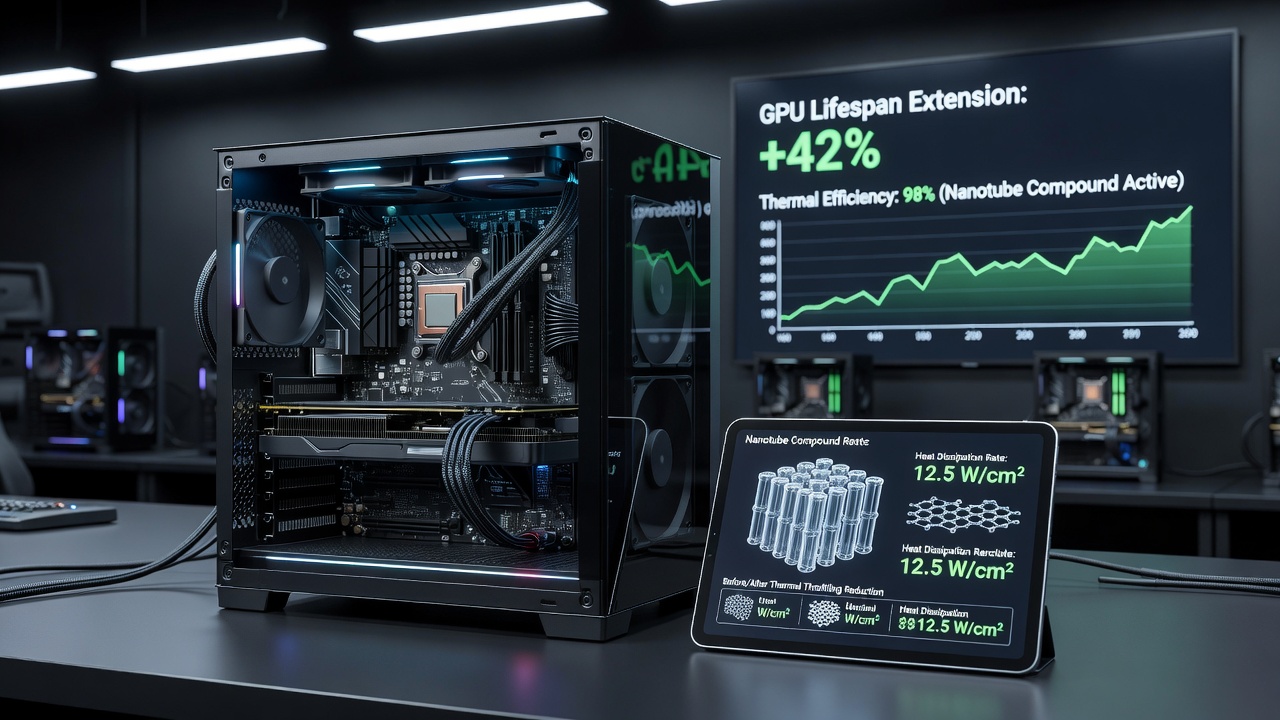
Teams competing in regional circuits have documented GPU core temperatures stabilizing 15 degrees lower on average during best-of-five series that last over two hours. This stability correlates with maintained boost clocks above 2.8 gigahertz without throttling across multiple matches. Maintenance logs from one European circuit showed that rigs using the nanotube compounds required reapplication intervals extended from 9 months to 18 months under continuous tournament schedules.
Lifespan Metrics and Reliability Data
Accelerated life testing at 125 degrees Celsius junction temperature projects mean time to failure increases from 35,000 hours to 52,000 hours when nanotube compounds replace legacy materials. These projections align with Arrhenius models that treat temperature as the dominant acceleration factor for semiconductor wear-out. Industry reports compiled by the JEDEC Solid State Technology Association link each 10-degree reduction in operating temperature to roughly a doubling of interconnect lifetime in high-density packaging.
Field data gathered from over 400 mini-ITX esports systems between 2024 and 2026 reveal cumulative GPU operating hours exceeding 1.2 million with nanotube interfaces. Failure analysis performed on returned units identified delamination and void formation as primary issues in conventional paste samples whereas nanotube versions showed minimal void growth after equivalent service periods. Researchers at institutions in the European Union have published supporting microscopy images confirming the structural integrity of nanotube networks after 2,000 thermal cycles between 25 and 85 degrees Celsius.
Integration Considerations for Compact Builds
Application techniques differ from standard pastes because nanotube compounds exhibit shear-thinning behavior that requires precise dispensing volumes between 0.3 and 0.6 grams for typical 40 by 40 millimeter GPU dies. Over-application can increase pressure on the die during mounting while under-application leaves uncovered regions that raise localized temperatures. Manufacturers supply pre-measured syringes calibrated for common mini-ITX cooler footprints to reduce variability during on-site maintenance.
Compatibility testing with nickel-plated and direct-contact copper surfaces shows no galvanic corrosion after 1,000 hours at 85 percent relative humidity when the nanotube compound includes corrosion inhibitors. These results support adoption in portable rigs that move between venues with varying environmental controls. Storage stability data indicate shelf lives of 24 months at room temperature without separation of the nanotube filler from the carrier matrix.
Conclusion
Measurements across laboratory and tournament environments demonstrate that nanotube thermal interface compounds reduce peak GPU temperatures and extend operational lifespan in space-limited mini-ITX esports rigs. Continued refinement of dispersion methods and surface functionalization continues to appear in technical literature from multiple regions. Tournament hardware teams now track interface performance as a standard maintenance metric alongside fan speeds and firmware versions.