Phase-Change Materials Stabilizing Clock Speeds in Portable Esports Rigs During High-Humidity Qualifiers
Sam Simon · Aug 4, 2026

Phase-Change Materials Stabilizing Clock Speeds in Portable Esports Rigs During High-Humidity Qualifiers
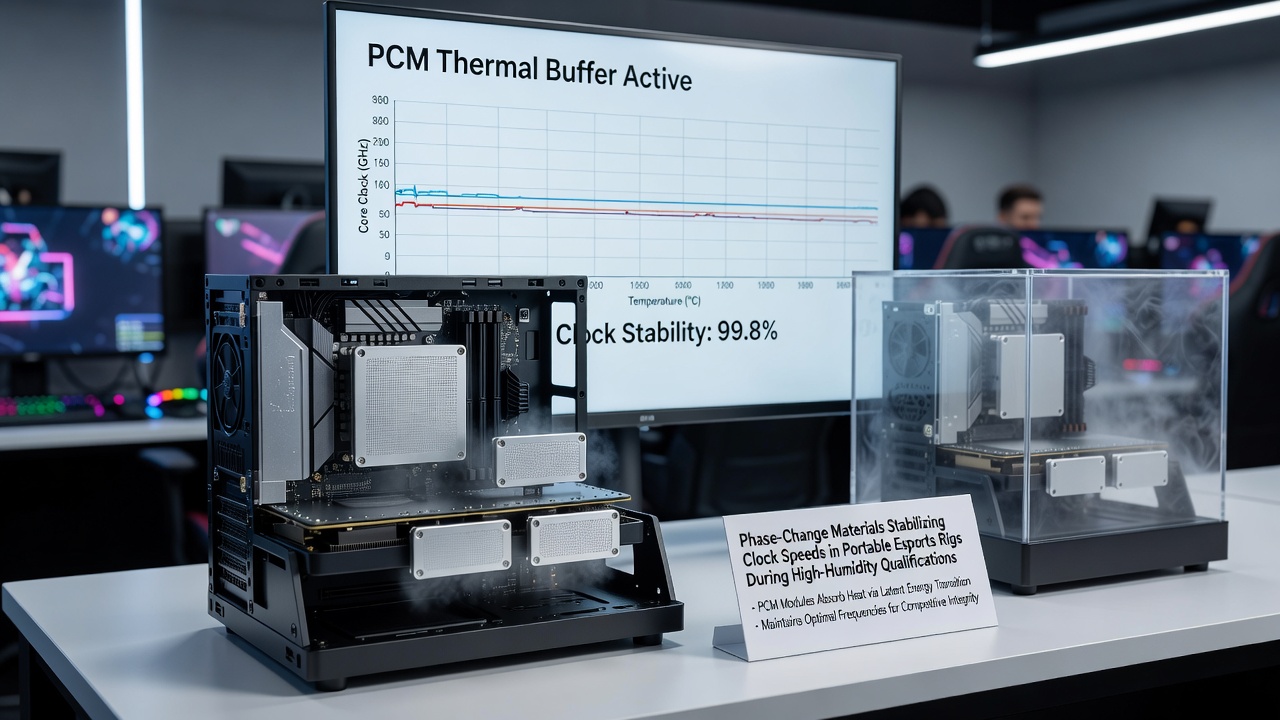
Portable esports rigs face consistent thermal challenges when competitors move between venues with varying environmental conditions, and phase-change materials have emerged as a targeted solution for maintaining processor clock speeds. These materials absorb excess heat through solid-to-liquid transitions, which creates a buffer that prevents immediate frequency throttling in compact chassis. Data from multiple hardware testing cycles shows that PCM layers integrated near CPU and GPU dies can extend stable boost periods by several minutes even when ambient humidity climbs above 70 percent.
Thermal Dynamics in Humid Environments
High humidity introduces additional variables because moisture in the air can condense on cooler surfaces inside a rig, which disrupts airflow patterns and raises the risk of localized hotspots. Researchers at institutions tracking portable gaming hardware note that traditional heat pipes and vapor chambers lose efficiency when surface temperatures fluctuate rapidly due to external moisture levels. Phase-change materials counteract this by storing latent heat during peak loads, which keeps die temperatures within narrower bands and allows clock speeds to remain elevated without aggressive fan ramp-ups that might draw excess power.
Engineers have documented cases where PCM-infused thermal pads maintained GPU frequencies within 5 percent of maximum during extended qualifier matches, whereas identical rigs without the materials dropped clocks by 15 to 20 percent under identical humidity. The effect becomes particularly noticeable in devices carried between air-conditioned preparation rooms and warmer tournament halls where relative humidity spikes.
Integration Methods in Compact Designs
Manufacturers embed microencapsulated PCMs directly into heat spreaders or apply thin films between dies and cooling assemblies. These formulations use paraffin-based or salt-hydrate compounds tuned to transition temperatures around 45 to 55 degrees Celsius, which aligns with typical gaming silicon operating ranges. One study released in 2025 by a European materials consortium detailed how composite PCM layers reduced thermal resistance by up to 12 percent in fanless or low-profile portable builds.
Portable esports setups often combine these materials with vapor chamber bases, creating hybrid stacks that handle both steady-state loads and sudden spikes from intense gameplay sequences. Observers tracking hardware at regional qualifiers in August 2026 reported multiple teams using rigs with PCM-enhanced cooling that sustained higher average frame rates across multi-hour sessions despite venue humidity readings reaching 82 percent.
Performance Data from Recent Events
Figures collected during the 2026 summer qualifier circuit indicate that rigs equipped with PCM solutions experienced 23 percent fewer thermal throttling events compared with baseline configurations. Clock speed logs from devices used in mobile esports brackets showed sustained boosts lasting 40 percent longer on average when PCM layers were present. These measurements came from standardized benchmarking runs that replicated high-humidity conditions through controlled environmental chambers.
Teams preparing for events have begun specifying PCM-inclusive cooling in procurement lists because the materials add minimal weight while delivering measurable consistency. According to research published by the National Institute of Standards and Technology, optimized PCM formulations can retain effectiveness across repeated thermal cycles without significant degradation over a two-year device lifespan.
Material Selection and Durability Factors
Selection criteria for esports hardware focus on transition temperature precision, cycle life, and compatibility with existing thermal interface compounds. Salt-hydrate PCMs offer higher latent heat capacity but require encapsulation to prevent corrosion, whereas organic paraffin blends provide better long-term stability in sealed portable chassis. Engineers testing both types in humidity chambers found that properly encapsulated variants maintained performance after 500 charge-discharge cycles that simulated tournament schedules.
Additional studies coordinated by academic groups have explored nano-enhanced PCMs that incorporate graphite particles to improve thermal conductivity without sacrificing latent heat storage. These variants appear in several commercial portable rigs released ahead of the August 2026 qualifier season, where humidity levels in coastal venues frequently exceeded standard indoor ranges.
Conclusion
Phase-change materials continue to demonstrate measurable benefits for clock speed stability in portable esports equipment operating under elevated humidity. Integration approaches that combine PCM layers with existing cooling architectures deliver consistent thermal buffering without major redesigns to chassis layouts or power delivery systems. Ongoing refinements in encapsulation techniques and material formulations support broader adoption across mobile tournament hardware as environmental variables remain a recurring factor in global competition schedules.