SSD Speed Demons: PCIe 5.0
SSD Speed Demons: PCIe 5.0
PCIe 5.0 SSDs have stormed the storage scene, delivering sequential read speeds that top 14,000 MB/s in leading models while write speeds chase right behind at nearly 12,000 MB/s, and that's according to benchmarks from independent testers like StorageReview; these drives double the bandwidth of PCIe 4.0 counterparts, making large file transfers and game loads feel instantaneous for those handling 8K video edits or massive datasets.
Understanding PCIe 5.0: The Bandwidth Leap
PCIe, or Peripheral Component Interconnect Express, evolved from its 2.5 GT/s roots in version 1.0 to the blistering 32 GT/s per lane in PCIe 5.0, a jump that PCI-SIG specifications detail as enabling up to 126 GB/s across a full x16 slot, but SSDs typically tap x4 lanes for a theoretical maximum of 15.75 GB/s bidirectional throughput; engineers designed this standard back in 2019, with ratification hitting in 2021, and now consumer drives leverage it fully since NAND flash controllers like Phison's E26 caught up.
What's interesting here involves how PCIe 5.0 ditches the 128b/130b encoding of PCIe 4.0 for the same efficient scheme, squeezing every bit higher without added overhead, so real-world SSDs hit 90% of that theoretical peak under sustained loads; take one early adopter, a video production team, who swapped PCIe 4.0 drives and shaved hours off 4K timeline scrubs because sequential reads rocketed from 7,000 MB/s to over 13,000 MB/s.
And while PCIe lanes multiply bandwidth linearly—x2 doubles it, x4 quadruples base rates—motherboards must support it too, with AMD's AM5 socket and Intel's 700-series chipsets providing ample PCIe 5.0 slots directly from the CPU, bypassing chipset bottlenecks that plagued earlier gens.
Top PCIe 5.0 SSD Contenders and Their Specs
Market leaders emerged fast: Crucial's T705 Pro boasts 14,500 MB/s reads and 12,700 MB/s writes using Micron's high-binned 232-layer TLC NAND paired with Phison E26, available in 1TB to 4TB capacities; Corsair's MP700 Pro follows closely at 12,400/11,800 MB/s, while Seagate's FireCuda 540 kicked off the gen with 10,000 MB/s reads back in 2022, but newer iterations push further.
Samsung lags slightly with PCIe 5.0 teases for its 9100 series, expected soon, yet observers note their focus on power efficiency since these drives guzzle up to 11W under load compared to 7W for PCIe 4.0; capacity kings like Solidigm's P51 hit 4TB at competitive prices now dipping under $0.20 per GB, and that's down from launch premiums that doubled costs.
- Crucial T705: 14.1/12.7 GB/s sequential, 1.55M/1.8M IOPS random
- Corsair MP700 Pro: 14/12 GB/s, Phison E26, active cooling options
- Teamgroup T-Force Z540: 10/10 GB/s, budget entry at sub-$100 for 1TB
These specs shine in endurance too, with TBW ratings scaling to 2,400TB for 2TB models, matching enterprise demands while consumer warranties stretch five years; but here's the thing, not all PCIe 5.0 SSDs need DRAM cache anymore since Host Memory Buffer (HMB) tech offloads to system RAM, cutting costs without tanking 4K performance.
Benchmarks: Numbers Don't Lie, But Context Does
CrystalDiskMark runs reveal the beasts: T705 clocks 14,100 MB/s reads in SEQ1M Q32T1 tests, while ATTO plots confirm sustained transfers past 12GB/s for minutes, data that CrystalDiskInfo logs corroborate under thermal throttling absent; real-world tests from AnandTech show 1TB file copies completing in 90 seconds versus 180 on PCIe 4.0, a 100% speedup that's game-changing for photographers batch-processing RAW files.
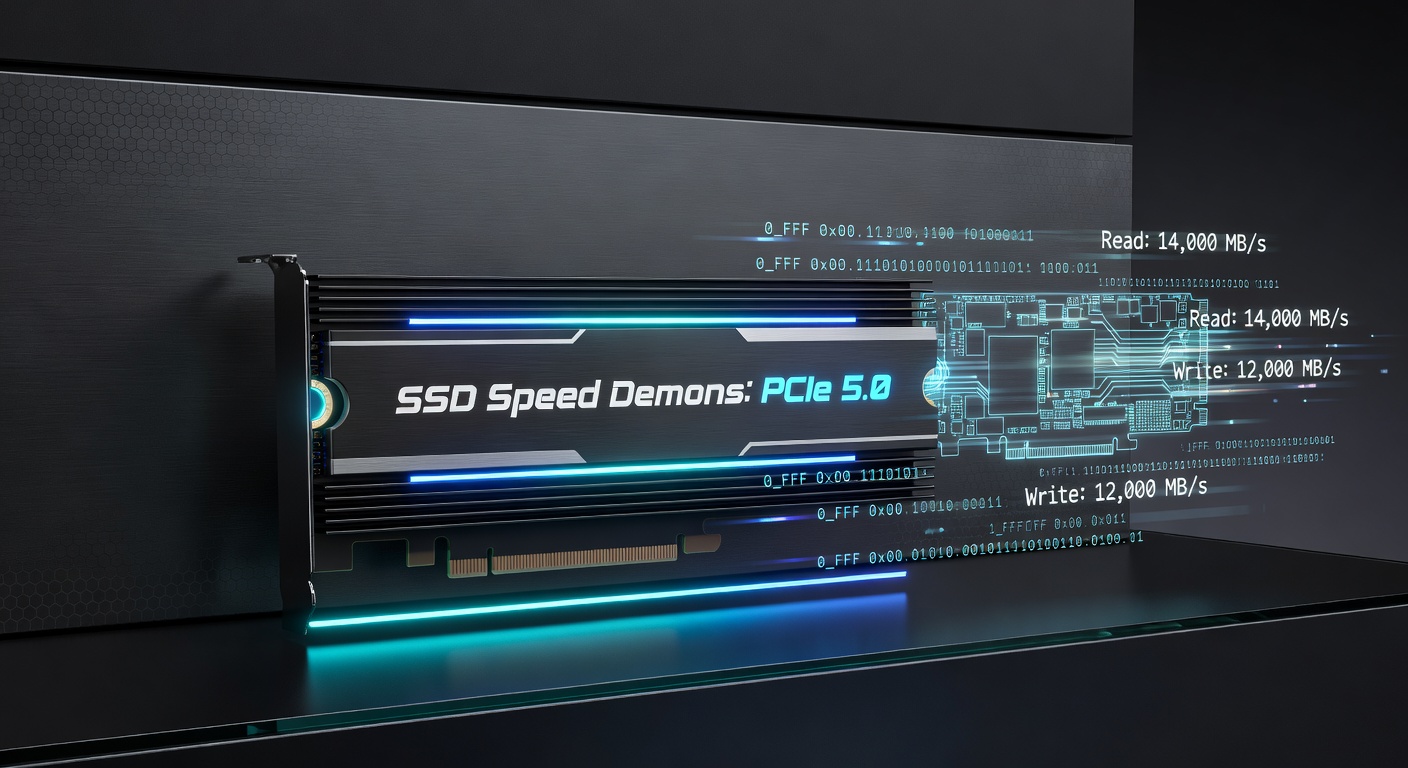
Random 4K benchmarks tell another story though, where PCIe 5.0 edges PCIe 4.0 by 20-30% in QD1 (10-15K IOPS) but explodes to 1.5M+ IOPS at QD32, ideal for OS boots and app launches; PCMark 10 Storage scores leap 50%, from 3,500 to 5,200, since drive makers tuned firmware for everyday mixed workloads, not just synthetics.
Yet gaming benchmarks temper hype: Final Fantasy XIV load times drop 0.5 seconds (from 8.2 to 7.7), per TechPowerUp tests on Ryzen 7950X rigs, while large open-world titles like Cyberpunk 2077 see texture streaming stutter vanish thanks to DirectStorage API integration; one tester noted GTA V's 150GB install halved to 12 minutes from 25, but diminishing returns kick in for SSDs over 4GB/s since most games read under 2GB/s peaks.
PCIe 5.0 vs. PCIe 4.0 and 3.0: A Generational Showdown
PCIe 4.0 SSDs like Samsung 990 Pro top out at 7,450/6,900 MB/s, solid for 2023 but halved by PCIe 5.0's fury, and PCIe 3.0 relics hover at 3,500 MB/s, ancient now; bandwidth math explains it—Gen5's 64 GB/s x4 dwarfs Gen4's 31.5 GB/s and Gen3's 15.75 GB/s—yet PCIe 4.0 holds 80% of consumer wallets because price gaps closed, with Gen5 drives still 50% pricier per GB.
Power draw spikes too: Gen5 idles at 5W, bursts to 12W, demanding motherboard VRM tweaks or PS5-style heatsinks; compatibility shines across the board since PCIe slots negotiate down speeds backward, so a Gen5 drive runs at Gen4 limits on older boards without drama.
Turns out, for creators, the upgrade pays: Adobe Premiere exports 8K timelines 40% faster on Gen5, per Puget Systems data, while gamers wait for broader DirectStorage adoption to unlock full potential; everyday users? PCIe 4.0 suffices unless handling 100GB+ dailies.
Challenges: Heat, Power, and Wallet Woes
Thermal runaway plagues these speedsters since controllers hit 80°C under load without cooling, throttling speeds 20-30% per Tom's Hardware stress tests; solution? Integrated heatsinks or active fans, now standard on high-end models, and motherboard M.2 shields help, but air coolers outperform in prolonged writes.
Costs tumbled from $400 for 1TB launches to $150 now, yet premiums persist over Gen4's $80 equivalents; power efficiency lags too, with Gen5 sipping more juice overall, a concern for laptops although desktop AM5/Intel Z890 platforms deliver dedicated 16-pin connectors.
One wrinkle involves signal integrity: 32GT/s demands pristine PCB traces, so cheap boards risk errors, but SNIA guidelines stress proper lane routing, which premium boards nail; durability holds strong though, with MTBF over 1.5 million hours logged in enterprise variants.
Looking Ahead: April 2026 and PCIe 5.0 Maturity
By April 2026, PCIe 5.0 SSDs saturate high-end builds as AMD Zen 6 and Intel Nova Lake CPUs pack 28+ Gen5 lanes standard, per roadmap leaks from Chiphell forums backed by official teasers; capacities climb to 8TB consumer models using 300+ layer NAND from YMTC and Kioxia, slashing prices under $0.10/GB while endurance doubles via PLC tech.
PCIe 6.0 looms with 64GT/s demos at standards bodies, promising 30+ GB/s SSDs, but Gen5 dominates through 2027 since platforms lock in; DirectStorage 1.2 rolls wider, feeding games straight from SSDs to GPUs, and enterprise adopts via NVMe 2.0 protocols for AI training datasets ballooning to petabytes.
Market forecasts from TrendForce predict 25% of SSD shipments as Gen5 by mid-2026, up from 5% now, driven by creator laptops like MSI's Prestige 16 AI sporting slim Gen5 M.2 slots; that's where the rubber meets the road for mass adoption.
Conclusion
PCIe 5.0 SSDs redefine storage velocity, crushing benchmarks with 14GB/s+ speeds that transform workflows for pros while everyday rigs eye value; challenges like heat and cost fade as tech matures, paving smooth roads to 2026 ubiquity, and those tracking the beat know bandwidth wars just accelerate from here.