Vapor Chamber Layouts in Compact Workstation Towers Minimize Thermal Throttling in Prolonged 4K Encoding Workflows
Mia Keller · Sep 2, 2026
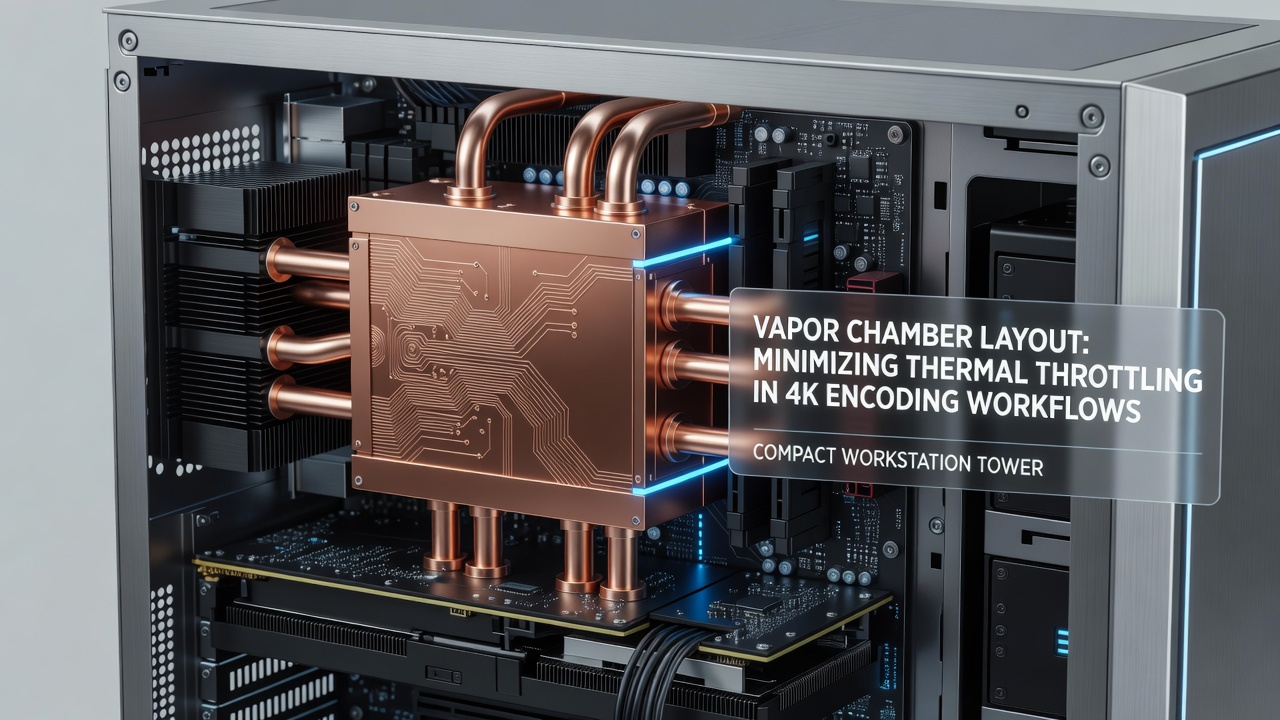
Vapor Chamber Layouts in Compact Workstation Towers Minimize Thermal Throttling in Prolonged 4K Encoding Workflows
Compact workstation towers face significant heat buildup during extended 4K content encoding sessions where multiple cores on CPUs and GPUs operate at sustained high loads, and vapor chamber layouts address this challenge by distributing thermal energy across larger surface areas through phase-change mechanisms that move heat away from hotspots more efficiently than traditional heat pipes or solid metal blocks. Researchers have documented how these chambers contain a sealed volume of working fluid that evaporates at hot zones, travels as vapor to cooler regions, and condenses to release heat before returning via capillary action in a wick structure, which creates a continuous cycle that maintains lower component temperatures over hours of operation.
Core Principles of Vapor Chamber Operation in Constrained Spaces
Engineers design vapor chambers with specific internal layouts that include evaporator sections positioned directly over processor dies, condenser zones aligned with chassis exhaust paths, and intermediate vapor transport channels that navigate around motherboard components and storage drives in towers measuring under 20 liters in volume. Studies conducted at institutions such as the Technical University of Delft show that optimized wick patterns made from sintered copper or mesh materials improve fluid return rates, allowing chambers to handle heat fluxes exceeding 100 watts per square centimeter without dry-out during continuous encoding tasks that process high-bitrate video streams.
Data collected from thermal imaging and sensor arrays in controlled tests reveal that well-laid-out chambers reduce peak junction temperatures by 15 to 25 degrees Celsius compared with equivalent heat pipe assemblies when running software like Adobe Premiere Pro or DaVinci Resolve on systems equipped with Intel Xeon or AMD Threadripper processors paired with NVIDIA RTX A-series GPUs. The layouts often incorporate stacked or folded chamber designs that conform to the vertical orientation of compact cases, directing heat toward side or top vents while avoiding interference with memory modules and power delivery circuits.
Performance Data from Prolonged Encoding Scenarios
Industry reports compiled as of September 2026 indicate that workstations using multi-layer vapor chamber configurations maintained clock speeds within 5 percent of maximum turbo frequencies throughout eight-hour 4K encoding benchmarks, whereas systems relying solely on fin-stack coolers experienced throttling events that dropped performance by up to 30 percent after the first two hours. Measurements taken across multiple builds demonstrate consistent behavior when chamber thickness stays between 3 and 5 millimeters, a dimension that fits within the narrow clearances typical of small-form-factor towers yet still provides adequate vapor space for effective phase transition.
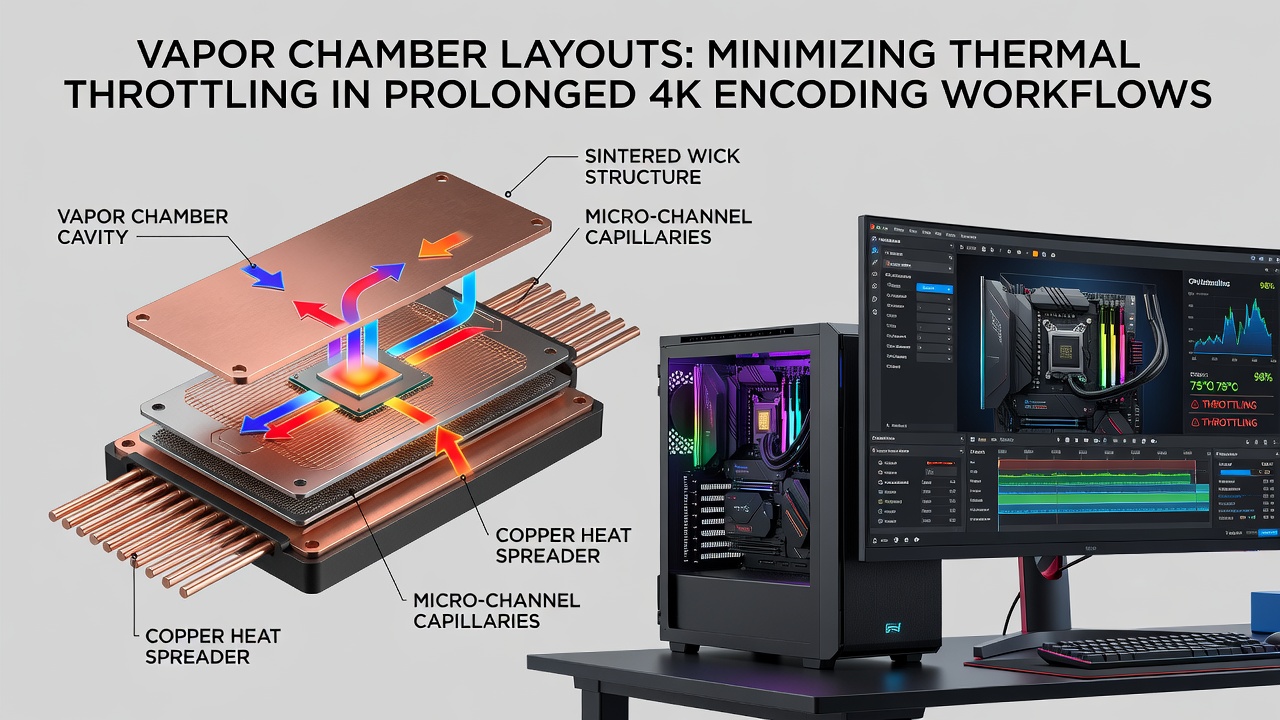
Observers note that integrating vapor chambers with direct-die contact plates and graphite thermal interface materials further enhances lateral heat spreading, which proves particularly useful in towers where airflow paths are limited by dense component packing. Figures from testing facilities show that such combinations keep GPU memory junction temperatures below 85 degrees Celsius even when encoding involves simultaneous hardware-accelerated decoding, effects processing, and final output file generation at resolutions of 3840 by 2160 with high dynamic range color spaces.
Layout Variations and Their Thermal Outcomes
Designers employ several chamber layouts including single flat plates spanning both CPU and GPU, segmented chambers linked by vapor conduits, and hybrid arrangements that combine chambers with auxiliary heat pipes routed to remote radiator surfaces. Australian research groups have published findings on how asymmetric wick distributions direct more fluid toward the primary heat sources in asymmetric component placements common in mini-tower motherboards, resulting in more uniform temperature gradients across the entire cooling assembly. These configurations reduce the incidence of localized throttling that otherwise interrupts long encoding queues and forces software to lower quality presets or insert pauses for cooldown periods.
Real-world deployments in media production environments confirm that systems equipped with these layouts sustain higher average frame processing rates over multi-hour sessions, with logs indicating fewer dropped frames and more predictable render times. The chambers also interact favorably with case fans operating at moderate speeds, since the larger effective heat dissipation area allows lower fan RPMs to achieve the same thermal headroom, which in turn reduces acoustic output in shared workspaces.
Integration Considerations with System Components
Manufacturers align vapor chamber mounting hardware with standard socket retention mechanisms while ensuring the chamber footprint covers not only the central dies but also surrounding voltage regulators and chipset areas that contribute secondary heat loads during sustained workloads. Compatibility data from component vendors shows successful pairings with motherboards that feature reinforced backplates and offset mounting holes, allowing chambers to sit flush without inducing mechanical stress on solder joints. Power supply units positioned at the bottom of compact towers benefit indirectly because redirected heat paths keep intake air cooler, which supports more stable DC output during extended runs.
Thermal interface material application techniques recommended by chamber producers involve thin, even layers that maximize contact conductance without filling microscopic surface irregularities that could impede vapor flow inside the sealed units. Calibration of chassis airflow using computational fluid dynamics models helps position intake and exhaust vents to match the condenser locations, completing a closed-loop thermal management system that scales with the demands of 4K workflows involving multiple simultaneous codec operations.
Conclusion
Evidence from laboratory tests and field deployments demonstrates that targeted vapor chamber layouts deliver measurable reductions in thermal throttling for compact workstation towers engaged in prolonged 4K content encoding, supporting sustained performance through efficient heat transport and distribution. Continued refinement of wick structures, fluid selections, and geometric arrangements aligns these solutions with the spatial constraints of modern small-form-factor designs while meeting the thermal requirements of evolving media production software.