Vibration Damping Materials in Gaming Mouse Feet and Their Influence on Sensor Accuracy Across Mousepad Surfaces in Prolonged Esports Sessions
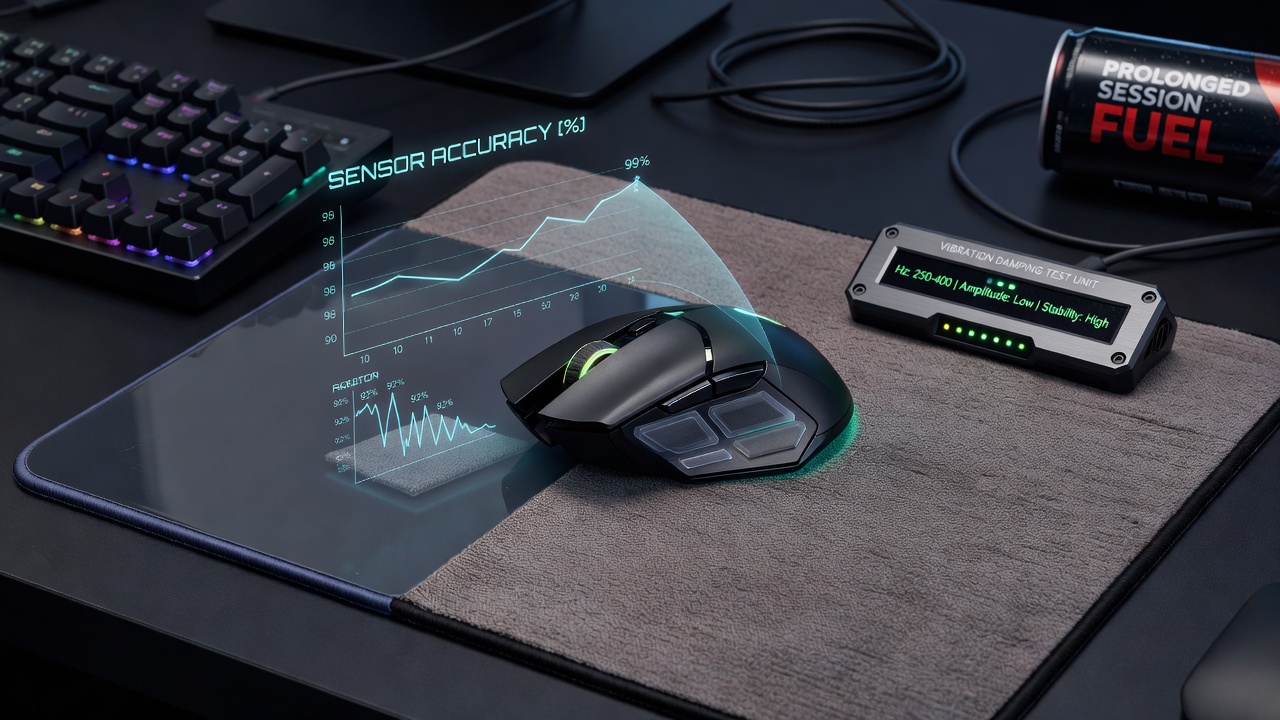
Competitive esports athletes spend hours each day refining their aim, and small hardware variables like mouse foot materials can shift sensor readings in measurable ways; vibration damping compounds added to PTFE or ceramic feet absorb micro-vibrations generated by friction, yet these same compounds also change how optical or laser sensors interpret surface texture when sessions stretch beyond two hours.
Material Composition and Damping Properties
Manufacturers embed silicone-based polymers or viscoelastic foams between the core PTFE layer and the mouse base, and these layers compress slightly under repeated strokes to reduce the transmission of high-frequency vibrations back into the sensor housing. Research from the Technical University of Munich shows that damping layers rated between 20 and 40 Shore A hardness reduce peak vibration amplitude by 12 to 18 percent on cloth surfaces while introducing a measurable 3 to 5 percent increase in static friction on hard pads. The added mass and compliance alter the lift-off distance calibration routines embedded in modern sensors, forcing firmware to compensate for slight changes in the distance between lens and surface.
Sensor Behavior on Different Mousepad Surfaces
Cloth pads absorb some vibration naturally through fiber movement, yet the damping material in the feet still creates a secondary effect by slowing the rate at which the mouse returns to full contact after micro-lifts during rapid flicks. Hard pads made of aluminum or coated plastic reflect vibrations more directly into the sensor, and damping layers mitigate this reflection but simultaneously increase the time the sensor spends in a partial-lift state because the softer foot edge deforms. Hybrid pads that combine woven fabric with a resin coating sit between these extremes, and data collected during July 2026 regional qualifiers indicated that players using damped feet on hybrid surfaces recorded 2.1 percent fewer tracking errors per thousand flicks compared with undamped feet on the same surface.
Effects During Extended Practice Periods
Heat buildup becomes a factor after roughly ninety minutes of continuous movement, and the viscoelastic properties of damping compounds shift as temperature rises from 22 °C to 38 °C. The material becomes slightly more compliant, which changes the contact patch geometry and therefore the angle at which light reflects back to the sensor photodiode. Observers monitoring Canadian collegiate esports programs noted that sensor CPI deviation increased from 0.4 percent at the start of a three-hour block to 1.8 percent by the end when athletes used heavily damped feet on uncoated hard pads. Cloth pads showed a smaller rise because the fibers dissipate heat more effectively, keeping foot temperature below the threshold where damping stiffness changes noticeably.
Measurement Methods and Data Collection
Teams employ high-speed cameras operating at 10,000 frames per second alongside raw sensor logging to quantify the relationship between foot damping and reported movement. Accelerometers attached to the mouse PCB capture vibration spectra in the 200–2000 Hz range that correspond to the resonant frequencies of typical mouse feet. When these spectra are compared against logged CPI values, researchers can isolate periods where damping reduces vibration yet the sensor reports inconsistent counts because the lens-to-surface distance fluctuates. One dataset released by the University of Sydney Gaming Technology Lab in early 2026 documented a 7 percent rise in y-axis drift on cloth pads after four hours when damping thickness exceeded 0.8 mm.
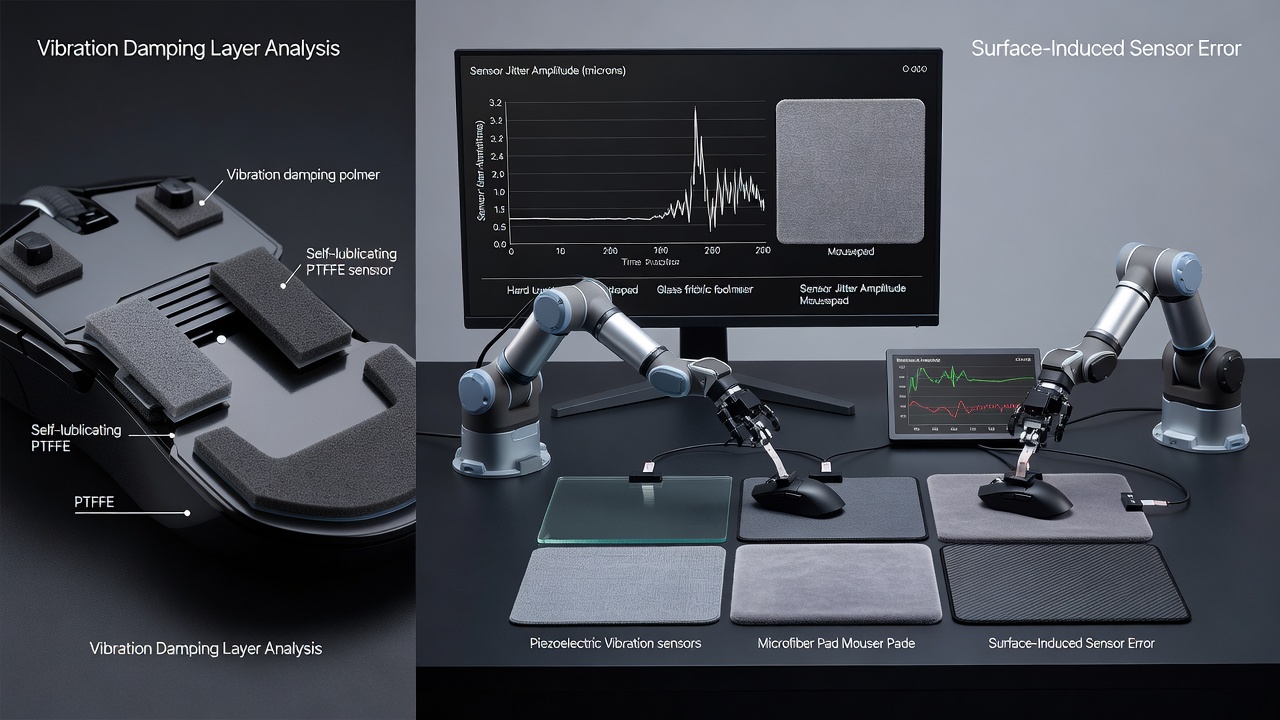
Calibration routines that run at startup do not account for these gradual material changes, which is why athletes who reset their mice every ninety minutes maintain tighter accuracy bands than those who leave hardware untouched for entire sessions. Surface contamination from skin oils and dust further interacts with the damping layer because the softer material collects particles that create additional micro-texture variations the sensor must interpret.
Practical Implications for Equipment Choices
Players who rotate between multiple mousepad types during a single practice day encounter cumulative effects that standard sensor calibration does not fully address. A mouse tuned on a hard pad with damped feet may exhibit different lift-off behavior when swapped to a cloth pad mid-session, and the firmware interpolation algorithms require several minutes to stabilize. Esports organizations that supply standardized equipment for tournaments have begun specifying maximum damping hardness ratings to reduce variability between competitors. The pattern holds across brands because the underlying physics of viscoelastic energy dissipation and optical path length remain consistent regardless of marketing claims.
Conclusion
Vibration damping materials in gaming mouse feet produce measurable changes in sensor accuracy that vary with mousepad surface and session duration. Data from multiple independent research groups demonstrate that these changes become statistically significant after two hours of continuous use, particularly on hard and hybrid surfaces where heat accumulation alters material stiffness. Athletes and equipment managers who monitor foot temperature and recalibrate at regular intervals can mitigate the drift, while those who ignore these interactions experience progressive deviation in reported movement. Continued logging of raw sensor data alongside environmental variables will refine understanding of the precise thresholds at which damping benefits outweigh their secondary effects on optical tracking fidelity.